:7 Warning Signs, Causes & Fixes
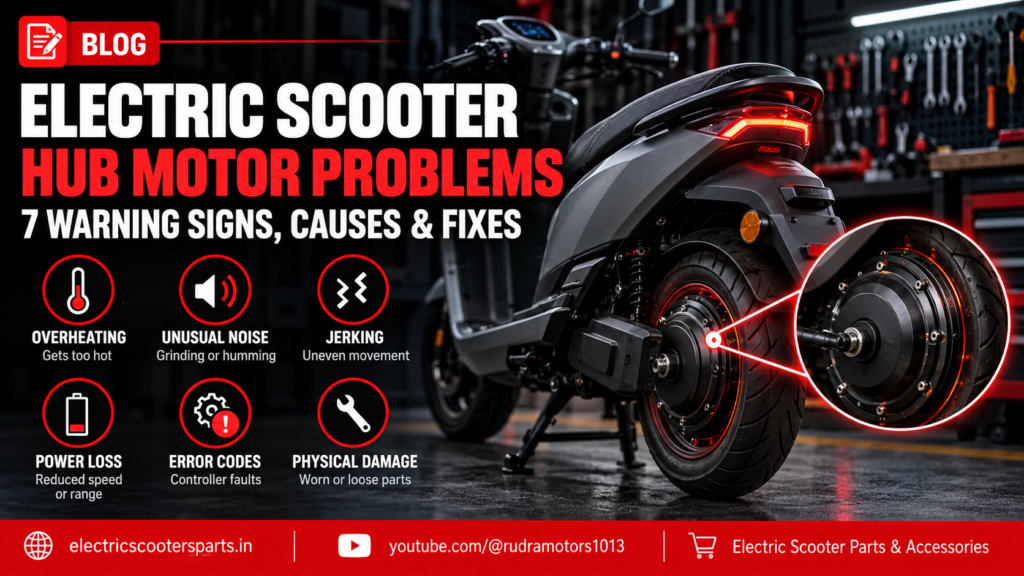
Electric scooters have become a popular choice for daily commuting in India because of their low running costs, convenient charging, and relatively simple maintenance. However, just like any other vehicle, electric scooters can develop technical issues over time.
One of the most important components responsible for your scooter’s performance is the hub motor. When it starts malfunctioning, you may experience unusual noises, poor acceleration, overheating, or even a complete loss of power.
Understanding electric scooter hub motor problems early can help you avoid unexpected breakdowns, unnecessary repair expenses, and damage to other electrical components.
In this guide, we’ll explore seven common warning signs, their possible causes, practical troubleshooting tips, and how to determine whether your motor needs repair or replacement.
What Is an Electric Scooter Hub Motor?
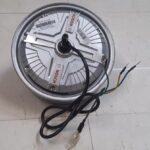
A hub motor is an electric motor integrated directly into a scooter’s wheel, commonly the rear wheel. Unlike traditional vehicles that use engines and complex mechanical transmissions, many electric scooters use brushless DC (BLDC) hub motors to drive the wheel.
The motor receives electrical power from the battery through a controller, which regulates the motor’s speed and torque according to throttle input.
A typical BLDC hub motor contains:
- Stator: Stationary windings that generate a rotating magnetic field.
- Rotor: The rotating component containing permanent magnets.
- Hall sensors: Sensors used in many motors to detect rotor position.
- Bearings: Components that help the wheel rotate smoothly.
- Axle and wiring: Parts that support the motor and carry electrical signals and power.
Hub motors generally require less routine maintenance than petrol engines because they have fewer moving parts.
According to the U.S. Department of Energy’s EV maintenance guidance, electric motors and associated electronics typically require relatively little scheduled maintenance compared with conventional combustion-engine components.
However, exposure to water, damaged wiring, excessive heat, and general wear can still cause operational issues.
7 Common Electric Scooter Hub Motor Problems
Recognizing early warning signs is important because a problem that initially seems minor can gradually affect scooter performance and reliability.
1. Unusual Grinding or Humming Noises
A healthy electric scooter hub motor generally operates smoothly with relatively little mechanical noise.
If you suddenly hear grinding, scraping, clicking, or unusually loud humming sounds, your motor or wheel assembly may require attention.
Possible causes:
- Worn or damaged motor bearings
- Loose internal components
- Damaged motor magnets
- Brake components rubbing against the wheel
- Incorrect motor phase operation
What should you do?
First, stop riding and check for visible damage or loose external components. A technician should inspect the wheel bearings, brakes, and motor.
If the noise occurs only when accelerating, the issue could also involve the controller or electrical connections.
2. Electric Scooter Motor Overheating
Overheating is another common symptom associated with electric scooter hub motor problems.
While some warmth is normal during operation, excessive heat can reduce motor efficiency and potentially damage internal insulation, sensors, or other components.
Possible causes:
- Riding continuously on steep inclines
- Overloading the scooter
- Incorrect controller settings
- Excessive electrical current
- Partially shorted motor windings
- Restricted wheel rotation due to brake or bearing problems
How to prevent overheating:
Avoid exceeding your scooter’s recommended load capacity. Reduce prolonged high-power operation on steep slopes and make sure the braking system is not creating unnecessary resistance.
If the motor becomes abnormally hot, produces a burning smell, or repeatedly loses power, stop using the scooter and arrange a professional inspection.
Do not touch a hot motor casing immediately after riding.
3. Scooter Jerks or Vibrates During Acceleration
Does your electric scooter shake, jerk, or struggle to accelerate smoothly?
Irregular motor operation may occur when the controller cannot correctly energize the motor windings.
Possible causes:
- Faulty Hall sensors
- Loose motor phase connections
- Damaged wiring
- Controller malfunction
- Internal motor damage
Recommended solution:
Have a technician inspect the motor connectors, phase wiring, sensor signals, and controller compatibility.
Motor and controller problems can produce similar symptoms, so replacing the hub motor without proper testing may not solve the issue.
For a better understanding of controller functionality, read our Beginner’s Guide to Electric Scooter Controllers.
4. Electric Scooter Suddenly Loses Power
A sudden loss of drive power can be frustrating, especially during daily commuting.
However, power loss does not always indicate a damaged motor.
Possible causes:
- Loose battery connections
- Battery management system protection
- Faulty throttle signal
- Damaged motor wiring
- Controller protection or failure
- Motor overheating protection, where supported
What should you check?
Observe whether the dashboard remains operational when the scooter stops accelerating.
If the entire electrical system shuts down, battery or power-supply issues may be involved. If the display remains on but the motor does not respond, the motor, controller, throttle, brake cut-off system, or connecting wiring may need investigation.
A qualified technician can narrow down the cause using the scooter’s diagnostic information and manufacturer-approved testing procedures.
5. Reduced Speed and Poor Acceleration
If your scooter takes longer than usual to reach normal speed, the motor may not be receiving or converting power efficiently.
Possible causes:
- Weak or degraded battery
- Low battery charge
- Faulty controller
- Excessive mechanical resistance
- Damaged motor connections
- Motor winding problems
Recommended solution:
Start by checking tyre pressure, brake drag, battery condition, and fault indicators.
If these components are working correctly, ask a technician to examine the motor and controller.
A motor with higher wattage is not automatically the solution. The replacement must be compatible with the scooter’s entire electrical system.
You can also explore our guide to matching an EV controller with a battery and motor to understand why compatibility matters.
6. Hub Motor Does Not Rotate
A motor that fails to rotate is one of the more serious symptoms of electric scooter hub motor problems.
Sometimes the scooter powers on normally, but the wheel does not respond when the throttle is operated.
Possible causes:
- Broken or disconnected phase wires
- Faulty Hall sensors
- Controller malfunction
- Brake cut-off switch malfunction
- Motor winding failure
- Internal mechanical seizure
What should you do?
Do not repeatedly apply the throttle if the wheel is locked, makes grinding noises, or struggles to move.
Switch off the vehicle and seek technical assistance.
A technician should identify whether the issue is mechanical, electrical, or related to the controller before recommending a replacement.
7. Water Damage and Corrosion Inside the Hub Motor
Indian road conditions can expose electric scooters to heavy rainfall, puddles, mud, and standing water.
Although some motors have weather-resistant designs, water resistance varies by model and does not guarantee protection against flooding or submersion.
Possible causes of water-related failure:
- Damaged motor seals
- Water entering through the axle or wiring path
- Corroded connectors
- Internal bearing corrosion
- Moisture affecting electrical insulation
Recommended solution:
Avoid riding through deep or flooded roads.
If you suspect that water has entered the motor, stop using the scooter and have it inspected before powering it on again.
A technician may need to examine the connectors, insulation, bearings, and internal motor components.
How to Diagnose Electric Scooter Hub Motor Problems
Correct diagnosis is essential before purchasing replacement parts.
Several scooter components work together to deliver power to the wheel. A fault in any one of them may create symptoms similar to motor failure.
| Symptom | Possible cause | Recommended action |
|---|---|---|
| Grinding noise | Worn bearings or brake rubbing | Inspect bearings and brakes |
| Motor overheating | Overload or electrical fault | Stop riding and check the system |
| Jerking acceleration | Hall sensor, wiring, or controller fault | Professional electrical diagnosis |
| No throttle response | Throttle, brake switch, controller, or motor fault | Check diagnostic codes and connections |
| Reduced speed | Battery weakness or motor-system inefficiency | Inspect battery and drivetrain |
| Wheel difficult to rotate | Mechanical damage or brake drag | Stop using and inspect |
| Problems after water exposure | Corrosion or moisture ingress | Professional inspection before reuse |
Safety note: Electric scooter electrical systems can carry hazardous voltage and high current. Internal motor testing, controller wiring checks, and battery disconnection should be performed according to manufacturer procedures by qualified personnel.
What Causes Electric Scooter Hub Motor Failure?
Motor damage can develop gradually or result from a sudden event.
Some of the most common contributing factors include:
Excessive Loading
Carrying loads beyond the scooter manufacturer’s limit places additional demand on the motor and electrical system, particularly during acceleration and hill climbing.
Improper Controller Compatibility
The controller determines how electrical power is delivered to the motor.
Incorrect voltage, current limits, control parameters, or wiring compatibility can cause poor operation or component damage.
Poor Road Conditions
Repeated impacts from potholes and uneven surfaces can place stress on wheel bearings, axle mounts, and associated components.
Water Exposure
Damaged seals and connectors can allow moisture to reach sensitive components, increasing the risk of corrosion or electrical faults.
Neglected Maintenance
Ignoring abnormal noises, brake drag, loose mounting hardware, or damaged cables can allow small issues to become more serious.
The U.S. Department of Energy’s motor maintenance guide also discusses how temperature, moisture, contamination, and wear can contribute to electric motor deterioration.
Should You Repair or Replace Your Electric Scooter Hub Motor?
Not every malfunction requires a complete motor replacement.
The right decision depends on the affected component, damage severity, repair availability, and the total cost involved.
When Repair May Be Possible
A qualified technician may be able to address problems involving:
- Replaceable worn bearings
- Damaged external connectors
- Repairable cable damage
- Certain Hall sensor faults
- Minor mechanical issues
Repair suitability depends on the specific motor design and availability of compatible parts.
When Replacement May Be Better
A complete motor replacement may be necessary when:
- Internal windings have suffered severe damage
- The rotor or magnets are extensively damaged
- The motor has severe corrosion
- Multiple internal components have failed
- Repair costs approach the price of a compatible replacement
If replacement is the recommended option, choosing the correct motor is essential.
For more information, read our complete guide to choosing the right electric scooter motor kit.
How to Choose a Replacement Electric Scooter Hub Motor
When replacing a faulty hub motor, selecting a component based only on wattage or appearance can lead to compatibility issues.
Consider the following factors.
1. Motor Wattage
Check the original motor’s rated power and your vehicle manufacturer’s specifications.
For example, an 800W motor and a 1200W motor are designed for different power requirements. They should not be treated as interchangeable without verifying the complete vehicle configuration.
2. Voltage and Controller Compatibility
Confirm that the replacement motor is designed to operate with your scooter’s battery and controller.
The motor’s electrical characteristics, sensor configuration, and controller operating limits must be compatible.
3. Wheel Size and Mounting
Hub motors are available in different wheel sizes and configurations.
Verify the original wheel dimensions, tyre fitment, axle measurements, mounting points, brake arrangement, and cable exit position.
4. Scooter Model Compatibility
Always check compatibility with your exact scooter model and variant.
A motor that fits one electric scooter may not fit another, even if the wheel sizes look similar.
5. Product Quality and Support
Purchase from a supplier who provides clear product specifications and compatibility information.
At Electric Scooter Parts, you can explore replacement components for different electric scooter models.
Explore Electric Scooter Hub Motor Replacement Options
If your existing motor is damaged beyond economical repair, replacing it with a compatible unit can help restore normal performance.
Here are two hub motor products listed on Electric Scooter Parts.
BOSCH 800W 10-Inch BLDC Hub Motor
The BOSCH 800W 10-Inch BLDC Hub Motor is listed for compatible EeVe Xeniaa, Xeniaa 2.0, EeVe 4U, and BGauss B8 electric scooters.
It features a 10-inch wheel configuration and an 800W motor rating.
Confirm the exact vehicle model, brake fitment, electrical connections, and other specifications before ordering.
BOSCH 1200W 12-Inch Hub Motor
The BOSCH 1200W 12-Inch Hub Motor is another listed replacement option, described as suitable for the Soul EV model.
Its 12-inch size and 1200W rating make it different from the 800W motor above.
These motors are not universal replacements, so always confirm compatibility before making a purchase.
You can also browse the electric scooter spare parts collection for other available components.
Tips to Prevent Electric Scooter Hub Motor Problems
Preventive care can reduce the risk of avoidable breakdowns and help maintain consistent vehicle performance.
Follow these maintenance practices:
- Avoid overloading: Stay within the manufacturer’s recommended carrying capacity.
- Keep tyres properly inflated: Low tyre pressure increases rolling resistance and energy consumption.
- Avoid deep water: Do not expose the motor to flooding or submersion.
- Monitor unusual sounds: Investigate new grinding, rattling, or vibration promptly.
- Inspect visible wiring: Watch for damaged insulation, loose external cables, or corrosion.
- Avoid prolonged excessive loading: Reduce sustained high-power operation when conditions place heavy demand on the motor.
- Schedule professional inspections: Ask a technician to check wheel bearings, brake drag, mounting hardware, and electrical connections when necessary.
Regular maintenance cannot prevent every possible fault, but it can help identify warning signs before they become expensive repairs.
For additional information about safe motor upgrades, explore our guide to upgrading an electric scooter motor safely.
Frequently Asked Questions
1. What are the most common electric scooter hub motor problems?
Common symptoms include unusual motor noise, overheating, jerking during acceleration, reduced performance, failure to rotate, and water-related damage. Some symptoms can also originate from the controller, battery, brakes, or wiring.
2. Can a damaged electric scooter hub motor be repaired?
Yes, certain issues such as worn bearings, damaged connectors, or some sensor faults may be repairable. However, severe winding damage, corrosion, or major internal mechanical damage may require replacement.
3. Why does my electric scooter motor make a humming noise?
A mild operating hum may be normal. However, loud or unusual humming accompanied by jerking or poor acceleration could indicate controller, wiring, sensor, or internal motor issues.
4. Can water damage an electric scooter hub motor?
Yes. If water enters a motor through damaged seals or cable openings, it can affect bearings, insulation, connectors, and other internal components. The level of protection depends on the motor’s design and condition.
5. How long does an electric scooter hub motor last?
There is no universal lifespan. Durability depends on motor quality, operating conditions, load, water exposure, electrical compatibility, and maintenance. A properly maintained motor may operate for many years, but failure can also occur earlier.
6. Can I replace my scooter’s 800W motor with a 1200W motor?
Not automatically. Such an upgrade requires checking controller capacity, battery discharge capability, electrical compatibility, mechanical fitment, braking, and the manufacturer’s specifications. A higher-wattage motor alone does not guarantee better performance.
Conclusion
Understanding electric scooter hub motor problems can help you recognise early warning signs and make informed decisions about maintenance, repair, and replacement.
Symptoms such as excessive heating, unusual noises, jerking, and loss of drive power should never be ignored. However, proper diagnosis is important because a controller, battery, throttle, or wiring fault can sometimes resemble motor failure.
If a replacement is necessary, always select a hub motor that matches your scooter’s mechanical and electrical specifications.
At Electric Scooter Parts, we offer a range of electric scooter components to support repairs and maintenance.
Explore Electric Scooter Spare Parts and Replacement Motors and find the right components for your vehicle.